3 Things I Loved, July 2026
Since I have this space, I want to keep a record of the things I loved each month. It can be a book, a movie, a song, an album, a manga series, something I saw on TV, or heard, a new recipe I tried, a dish I ate, or even a material object. Why? Because it’s fun to talk and read about beloved things!
So, in July 2026, I got really into:
1. A day of secondhand shopping
Early in the month, I was finally motivated enough to check out Amcorp Mall’s weekend vintage market because they were hosting a Book Collectors Market. I had on my mind the intention to spend a leisurely afternoon browsing the old books on sale and to pick up a few bookmarks made by the indigenous weavers I knew would be there.
Of course, I quickly was drawn into the deeper parts of the mall beyond the books, and found myself losing hours to looking at CDs, trinkets, clothes, furniture, postcards, spread across the mall’s multiple floors. It was so much fun! I was thrilled by the long-forgotten physical sensation of flipping through a rack of CDs. The smack of the plastic cases against each other, fingers flip-flip-flipping through until you find the one you want. It made me wonder what other embodied memories we’ve lost and forgotten as technology marches on.
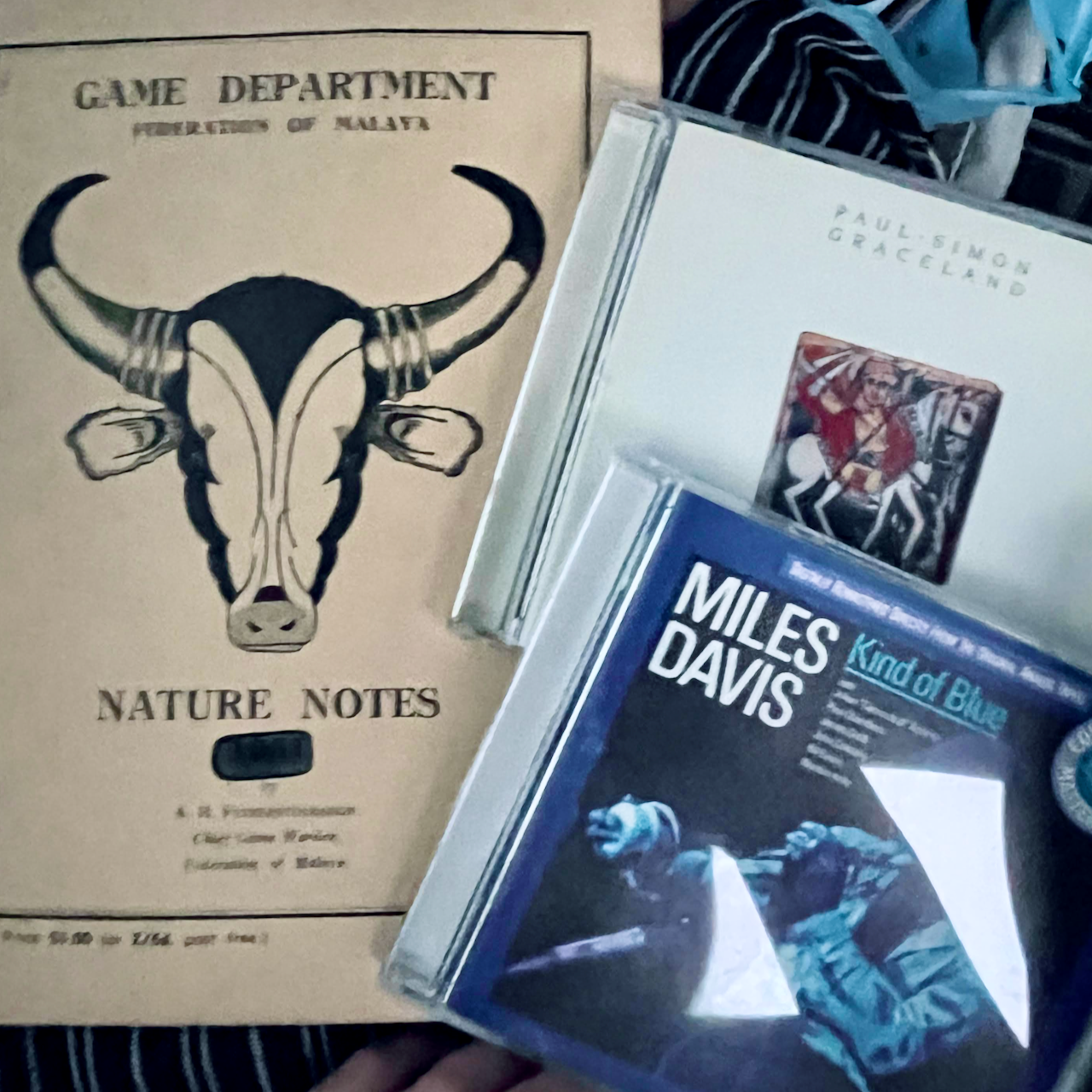
In the end, I left the CD shop with two lovely and long searched for albums: Miles Davis’ Kind of Blue and Paul Simon’s Graceland. I put them on when I got home and could not get up to do anything until they were done playing in their entirety. Speaking of lost things, there’s something to be said about the deliberate, holistic listening of albums that I’d forgotten in favour of Spotify playlists. The CDs reminded me that musical albums are a complete artistic object as much as a chapbook of poetry or an anthology of short stories (more on this later). And reading the liner notes as the album played was so great. Music CDs were so expensive last time that basically all I owned in childhood were bare bones pirated copies, so I had never realised.
I also bought some old bank notes (banana money from the time of the Japanese occupation), an old postcard with a yet unobstructed view of the Tokyo Tower, a pamphlet of local wild game from when Malaysia was still called Malaya, and a rattan ball for my dog from the weavers who made my bookmarks.
I found myself enthralled by the age of some of the things on sale, and how defiant they remained against time and the unrelenting, just as destructive humidity of our climate. I walked around for hours searching out traces of my past, sighing at things I would once have been able to see in my grandparents’ house, or maybe in my childhood, all now lost.
2. Short stories
This was brought on by two things: a rejected submission, and a very timely and excellent essay on fanfiction and short stories by Beth Weeks, editor of OFIC Magazine. The essay, which argues for the “implosive” quality of a short story as its defining feature, brought my fascination with the form right back into focus. I hadn’t thought seriously about short stories since my literary criticism and creative writing classes a lifetime ago, and for years I had been rather mindlessly cycling and submitting the same few stories I’d written while losing sight of what a short story could and should actually do.
Beth writes:
In brief: short stories implode, novels explode. By “implosion” I mean short stories don’t necessarily work toward a climax but more often what I call an “illuminating moment,” a moment which, once reached, casts the rest of the story in a new light. Sometimes it’s a reveal, or a twist, or a brief moment of lucidity. The momentum of a short story relies on tension, the relationship between the text and the reader where the reader is going “there is a reason for all this but I don’t know what it is yet.” The payoff happens when a story justifies itself and solidifies its themes. When a short story implodes, things like conflict resolution and denouement are far less important than illumination. The shorter something is, the less conclusive the ending needs to be in order to feel satisfying.
It struck me with a sense of familiarity, and I realised I had once known this. It was something we had once discussed in class while studying modernist short fiction, but back then we had looked at it through James Joyce’s concept of epiphany. I had forgotten until that moment.
Compelled, I decided to read some short stories just to see if I could find that moment of illumination/epiphany. I began a practice: I read a story and mark the parts that catch my eye as I try to discern what the author is doing. If possible, I flag that illuminating moment— though not all stories have or need one. When I’m done, I write a few lines of my thoughts in in a slim pocket notebook that I keep attached to the book. In the same notebook, on the calendar pages, I also write the title of the story I read next to the day’s date.
I started with what I had closest to hand: Flannery O’Connor’s A Good Man Is Hard To Find. It turned out to be a good choice simply because Flannery O’Connor is so good and her stories are so rich with intent, illumination, violence, and grace.
I limit this short story reading practice to just the morning; I read for as long as it takes me to finish my cup of coffee. I usually finish a story in about two days this way. (Sorry to Edgar Allan Poe who suggested that the short story’s strength lies in its ability to be read in a single sitting.) This artificial, arbitrary restraint has made me look forward to my reading sessions with the same eagerness as I do my morning coffee. I find myself thinking about the stories throughout the day, turning what I’ve read over in my head, looking forward for morning to come so I can pick it back up again.
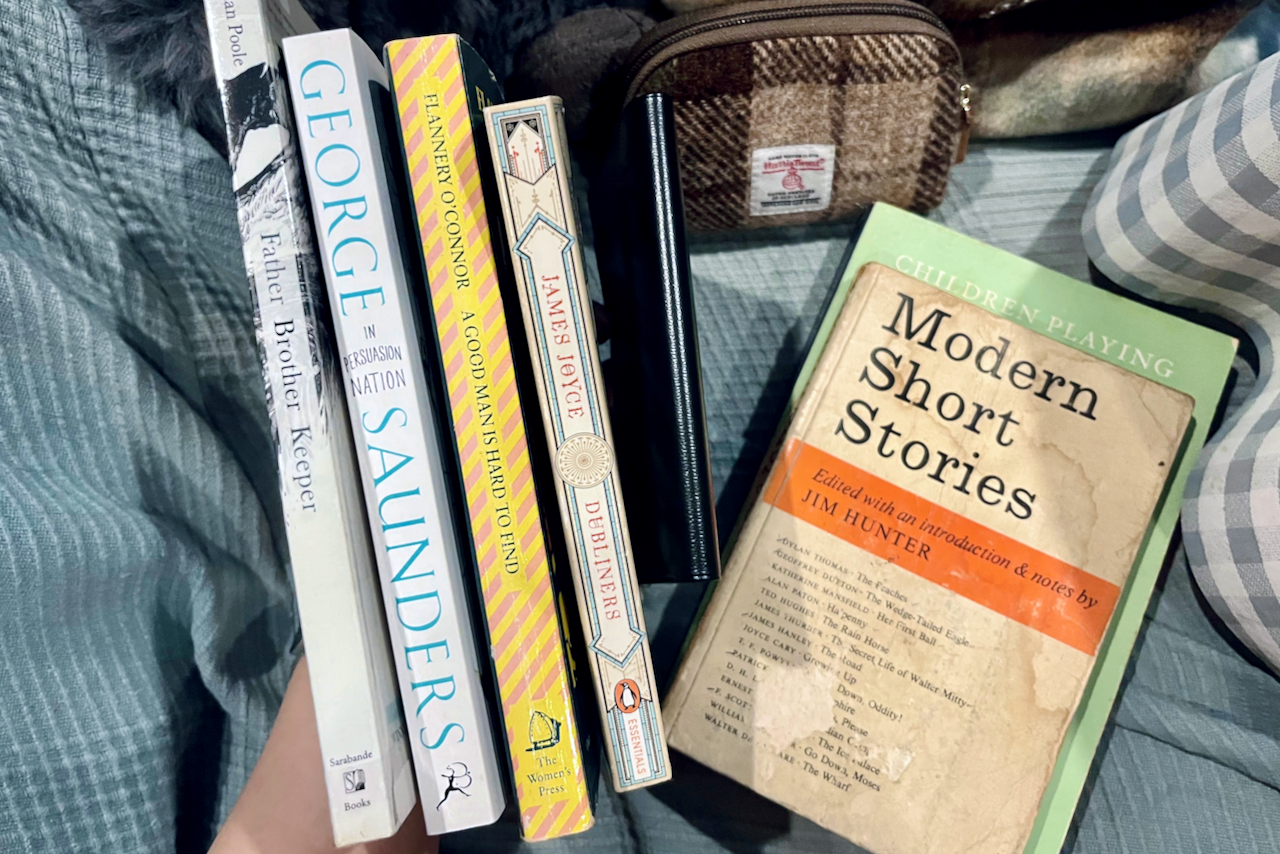
P.S. I’m also enjoying the hunt for more short story collections, gradually adding on to what I have so far, picking them up from secondhand sources wherever possible. I am especially determined to find Flannery O’Connor’s second anthology, and the full collections of Katherine Mansfield and Shirley Jackson…
3. Knitting
After a few months’ break, I got back into knitting (which also inspired this month’s post)! I started up some projects, sorted out my gear, and before I knew it, I was looking forward to knitting as many rows as I could for the duration of one mindless yet compelling enough episode of a TV show. I struggled with a lot of anxiety and anxiety-inducing situations this month, and while knitting didn’t make it go away, it dampened it enough to pass the hours.
It wasn’t just knitting I enjoyed, but also everything around it, the tools and paraphernalia that enrich and enable the practice. I took particular joy in purchasing a new plaid project bag, transferring my entire interchangeable needle set into a slim and compact fabric case that’s smaller than my Kobo, and making adorable makeshift needle stoppers out of unused Nintendo Switch thumb stick grips.
31 July 2026