Knitting Life Lessons: What You Gain When You Teach Yourself How to Knit
In July 2023, in the midst of writing a far overdue Masters thesis and simultaneously navigating the logistical and psychological difficulties of living in two countries, I decided it was the perfect time to teach myself how to crochet.
Once my confidence was safely bolstered by the success of this endeavour, I was ready for the next fibre art challenge: knitting. This was far more difficult. Nothing could have prepared me for knitting. Manoeuvring two needles this time, in concert with a ball of yarn and basically all my fingers seemed impossible. I could barely parse the motions I was supposed to replicate; I physically could not move the way I needed to. My knowledge of crochet did not help at all, except in the one arguably most important way: it was proof that I could learn.
Over weeks, I taught myself. And I did manage to knit in the end. It’s been incredibly rewarding. In the past two years, I’ve learnt so much about knitting, and I’d like to recount some of what I’ve learnt here. Don’t get me wrong: these are literal lessons of the craft, but maybe it’s no accident that they might also have somewhat metaphorical applications to life.
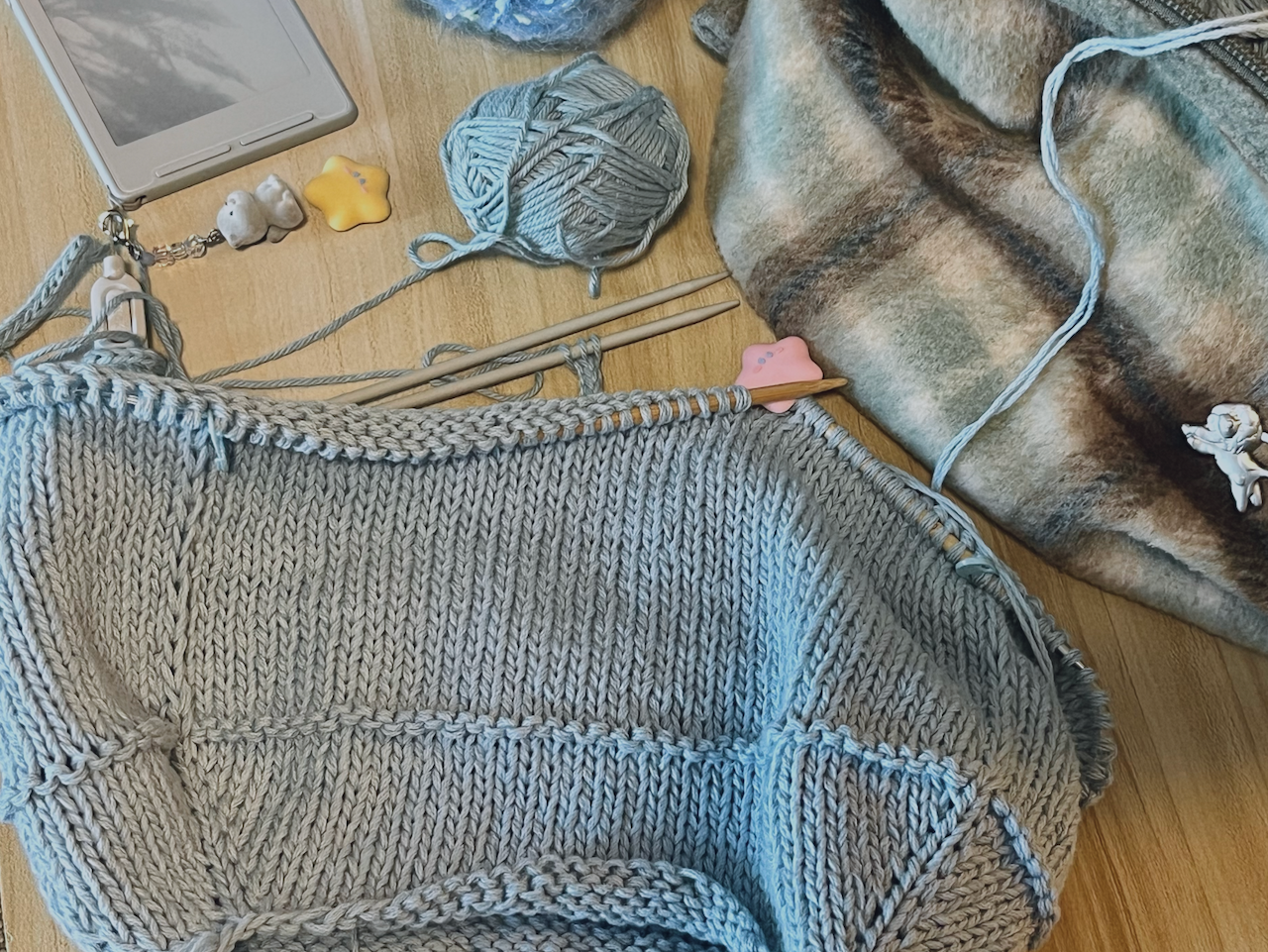
A knitting project in progress.
1. Take one step at a time
It’s very tempting to feel like you need to know how to do every part of a knitting pattern before you start. You don’t! You can simply take it one step at a time, looking up how to do something when you come to it. Crossing the bridge and all that. You don’t need to have all the answers at one go. All these problems, all the things you aren’t sure about, can be solved later when they arise. Trust in your ability to do that. There’s no point worrying about part B of a pattern when you haven’t even gotten through part A. Likewise, why worry about the problems that lie in wait in the future when you haven’t yet lived through the present?
2. But fix problems as soon as they arise
I recently started a project I was really enjoying only to realise, about a quarter of the way in, that I had misread the very first step of the pattern and built the entire project on a mistake. It was possible, but not guaranteed, that the mistake could be worked with later. Well, it would either work or it would render the project utterly unusable. Not all mistakes are as dramatic as that. Sometimes it’s just a little slip up that doesn’t jeopardise the project’s integrity in any way, but remains starkly visible.
It’s hard enough to acknowledge a problem, even harder to put in the effort to address and resolve it. You’d have to undo all your work so far and start over. Faced with the prospect of double work, it’s tempting to just ignore such mistakes. But then you end up with a completed but imperfect piece. Which is fine if that’s what you want, and if you can live with it, but I’ve found it’s always worth it and much better to confront the mistakes head on and correct them. (Which isn’t to say I do it all the time, in knitting or in life.)
3. You forget and you remember
This sure seems to be a running theme for me. Forgetting and remembering. With knitting, there are so many different stitches and techniques to keep track of— I’m always looking up how to do things and then forgetting them by the time I encounter them in another pattern. I blank on techniques I’ve taught myself before, sometimes things as simple as which hand my working yarn should be on. I don’t know why. It’s frustrating to feel like I’m starting from scratch each time, but I try to tell myself that if I’ve learnt it before, I can learn it again. My Youtube search history and the finished objects around my home serve as proof of that. It’s not all bad. Just as you trust your capacity to learn new things, trust also in your ability to relearn what you’ve learnt before.
4. Sometimes you just have to start
Unlike many other creative pursuits, starting a knitting project is far more tedious than actually executing it. The flow of knitting—working all those mindless rows of stockinette stitch or working up to the slow reveal of cables—is great, but it can be so difficult to get there. There is all the mathematics you have to do in figuring out sizing and yarn amounts, knitting a gauge swatch, more maths, more measurements and calculations, adjusting needle sizes, counting every cast-on stitch, and so on.
But you can’t get around it if you want to knit, and neither can you wait for the mood to strike you, because it won’t. You simply have to force yourself to get started and get through the pain of setting up the project so you can actually do it. Sometimes you just have to do the shitty unpleasant work before you get what you want.
5. What to do when faced with tangled yarn
Any knitter has surely experienced this. When you’re making something from a single strand of yarn often hundreds of meters long, it can easily become a mess of knots that looks impossible to work through. So where do you start? What do you do when everything is going wrong?
The answer, I’ve learnt, is to start with the easiest knot. You undo that, and then move on to the next easiest knot. And then you work your way through the rest, knot by knot. No matter how impossible it seems. And you can’t get frustrated— the more you yank at the knots, the worse it gets. You also can’t procrastinate by pulling out as much free flowing yarn as possible— the knots are still there waiting for you and eventually you will encounter them. You just have to untangle the yarn, going at it slowly, methodically, knot by knot, and trust it will be done.
6. Nothing is wasted
One of my favourite things about knitting is how nothing is really truly permanent. You can take a finished sweater in your closet right now, unpick a seam, undo every stitch, and unravel the yarn to be used in another project. So committing yarn to a project doesn’t mean you lose it forever. Similarly, your time spent knitting isn’t wasted either. Even if you made mistakes, you still learnt something from it.
7. To age is a gift
When I decided I did like knitting enough to invest in it, I purchased a collection of bamboo knitting needles from a secondhand store. They are all of different lengths, so they must have been collected over a long time, not bought in a whole set. Whoever owned these needles before me loved them and used them well. It is evident from how the bamboo tips have been polished to a high, slick sheen as a result all the loops of yarn that have slipped over it, from one needle tip to another, over the years.
These old needles are still the most pleasant needles to use in my collection. And I know it’s their age, not their make nor model, because needles of the same brand I bought fresh do not feel the same. There is no replacement for age and experience. I grimace inwardly each time I hear (arguably still young) people lament over “getting old(er)”. To age is to accumulate damage, sure, but that’s just the price of living. You accumulate damage but also experience, lustre, more and more perfection. To age is a gift. What is the alternative?
8. Physicality matters
More importantly, knitting gives me a way to ground myself and locate myself in both space and time. With my lifestyle, things often blur into a smear of sameness and dislocation. But when I hold something I knitted in my hands, I remember exactly where I was, how I felt, what I was doing when I was knitting it. The finished item is a sort of embodied memory that’s as strong of a trigger as scent or a song, and that too is a gift.
28 July 2026