What I Learned From Keeping a Commonplace Book for Ten Years
For the past decade, I’ve kept a commonplace book.
Every commonplace book starts as a blank notebook that serves as a place to collect and organise information. Though a commonplace book can hold any form of useful information that one might want to keep at hand, commonplacing is probably best known for its close ties to reading, as the historian Robert Darnton describes in an article on commonplace books for The New York Review. At its most basic, commonplacing involves copying out, by hand, passages or phrases encountered while reading into a notebook of one’s own— their commonplace book.
The practice has a long history, with commonplace books existing in some form or other throughout the years and with much study dedicated to the different commonplacing techniques and organisational systems employed in the past. This makes sense when you consider that book ownership was rare, books were prohibitively expensive, and printing presses—much less photocopiers—did not exist. Commonplace books were a way to keep words you loved close to you be easily referred back to.
Commonplacing made the act of handwriting inseparable from that of reading— two of my favourite interests. Copying out a passage, turning the words over in your head at the slow speed it takes your hand to transcribe it onto the page, provides a matchless way of dwelling on a piece of writing that has for some reason stuck with you.
But even more alluring than that was the promise that “by keeping an account of your readings, you made a book of your own, one stamped with your personality.” Every commonplace book becomes a one-of-a-kind book that is a unique reflection of its creator and their particular interests. Keep flipping through a commonplace book, Darnton promises, and a whole life emerges.
Well, it hasn’t yet been a whole life for me, but I’ve kept a commonplace book for a decade now. Commonplace books is more accurate— I’ve filled up three A6 sized notebooks since.
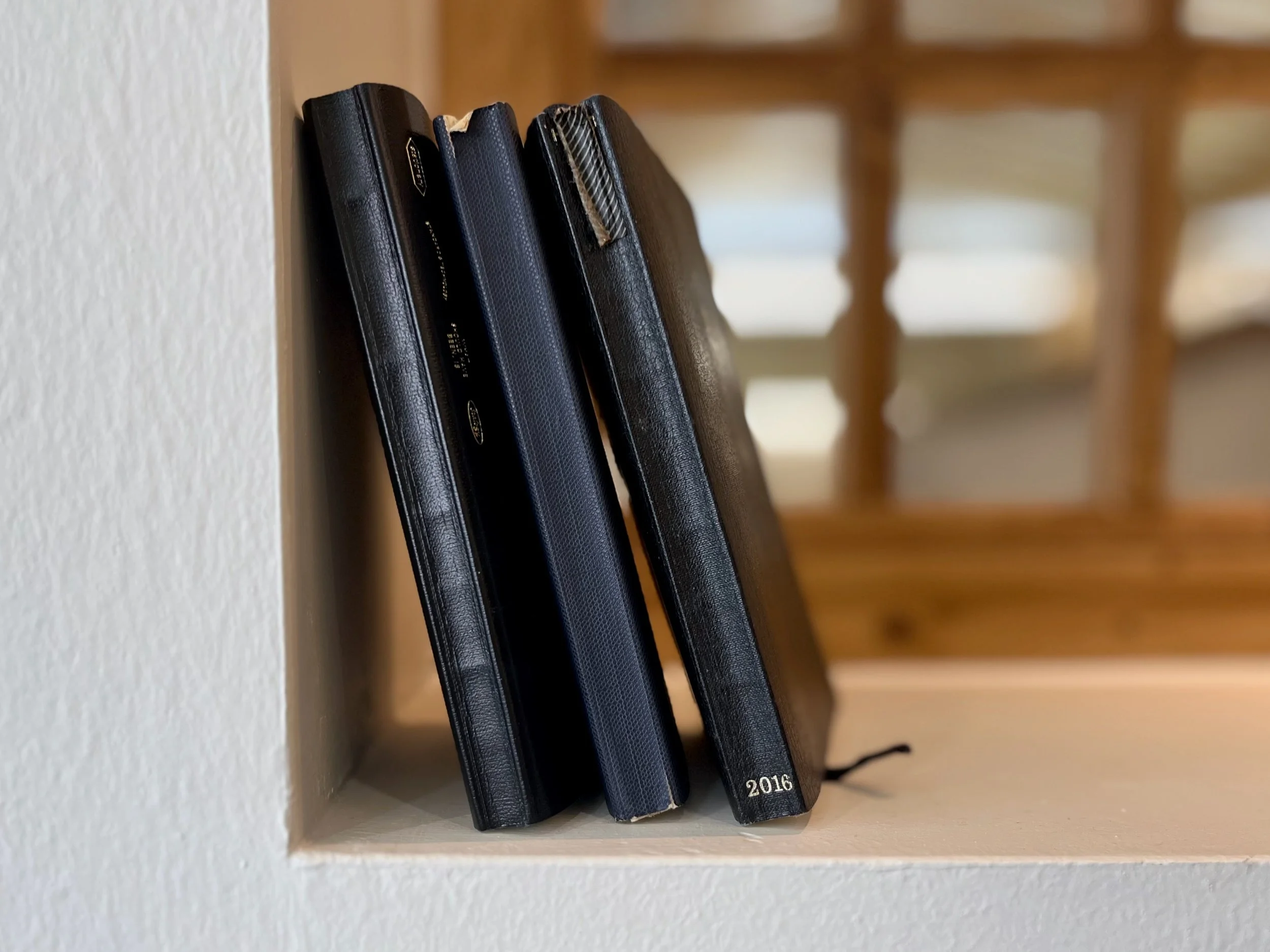
My commonplace books of the same size but different brands. From left: Stalogy, Taroko Design, Hobonichi.
I initially went through my commonplace books with the intention looking for material that might work well for future blog entries. And then I realised that the books themselves and the act of commonplacing were worth writing about. After all, each book is a record of what I loved and thought worthy of keeping over time, and how my commonplace practice has also evolved in line with my life.
❦
Volume 1 (2016 - September 2020)
My first ever commonplace book is an oddity, one that started only because I was sent a spare Hobonichi journal to replace one that came with mildly defected pages. Looking at the journal, I realised that its multiple calendar pages and one-day-a-page layout actually made for an excellent indexing system, and decided to turn the defected into a commonplace book. Daily dates took the places of a standard page numbering, and the system worked beautifully.
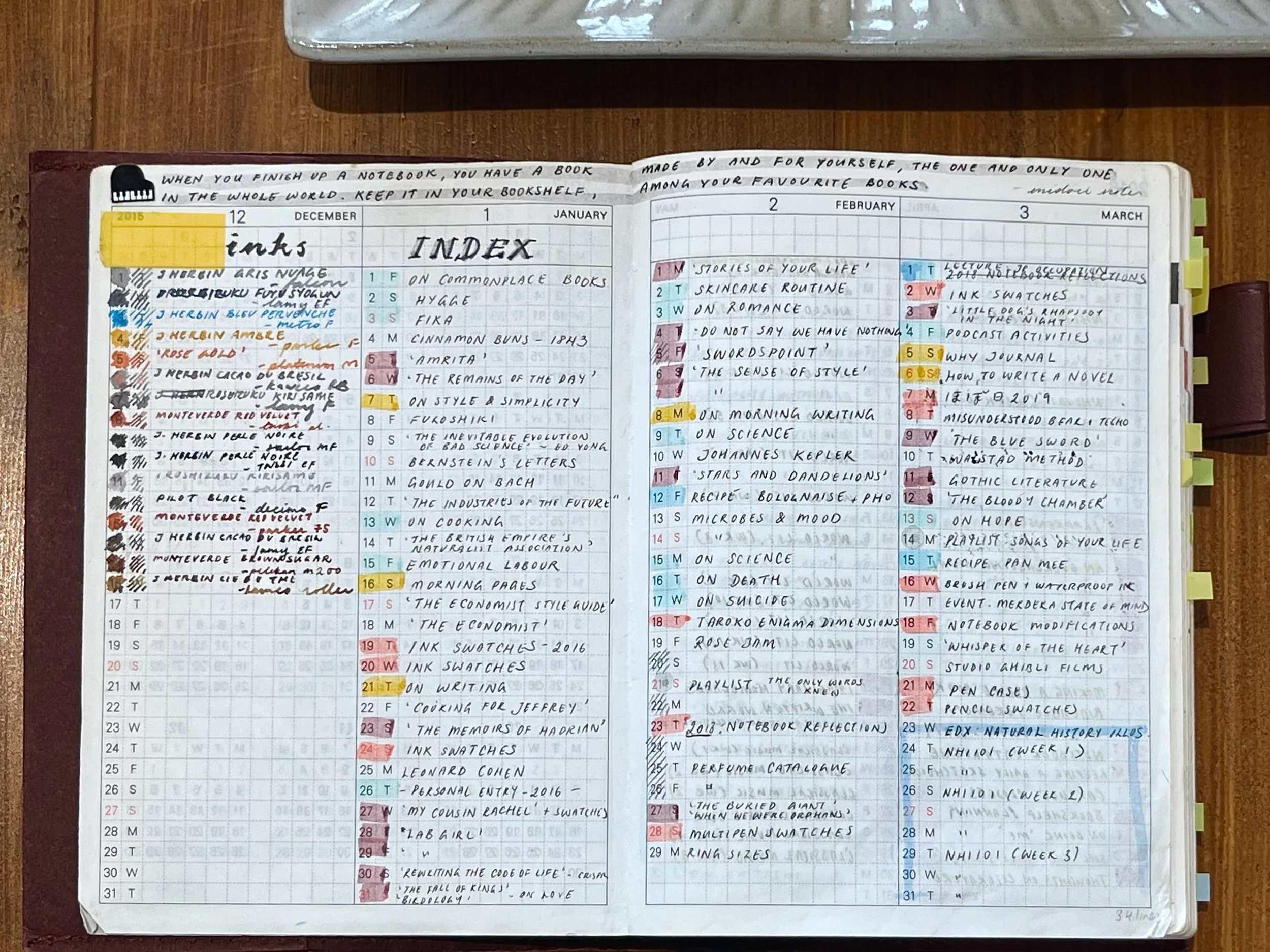
The index made use of in-built calendars and dates in lieu of page numbering.
I never realised until now how much hope and excitement this book held. In 2016, I was clearly discovering what I loved—literature, cooking, handwriting, love—and plunging head first and happily into the deepening of that experience. Notes from lectures, online courses, excerpts from books, and new “favourite” and “best of” lists dominate the pages.
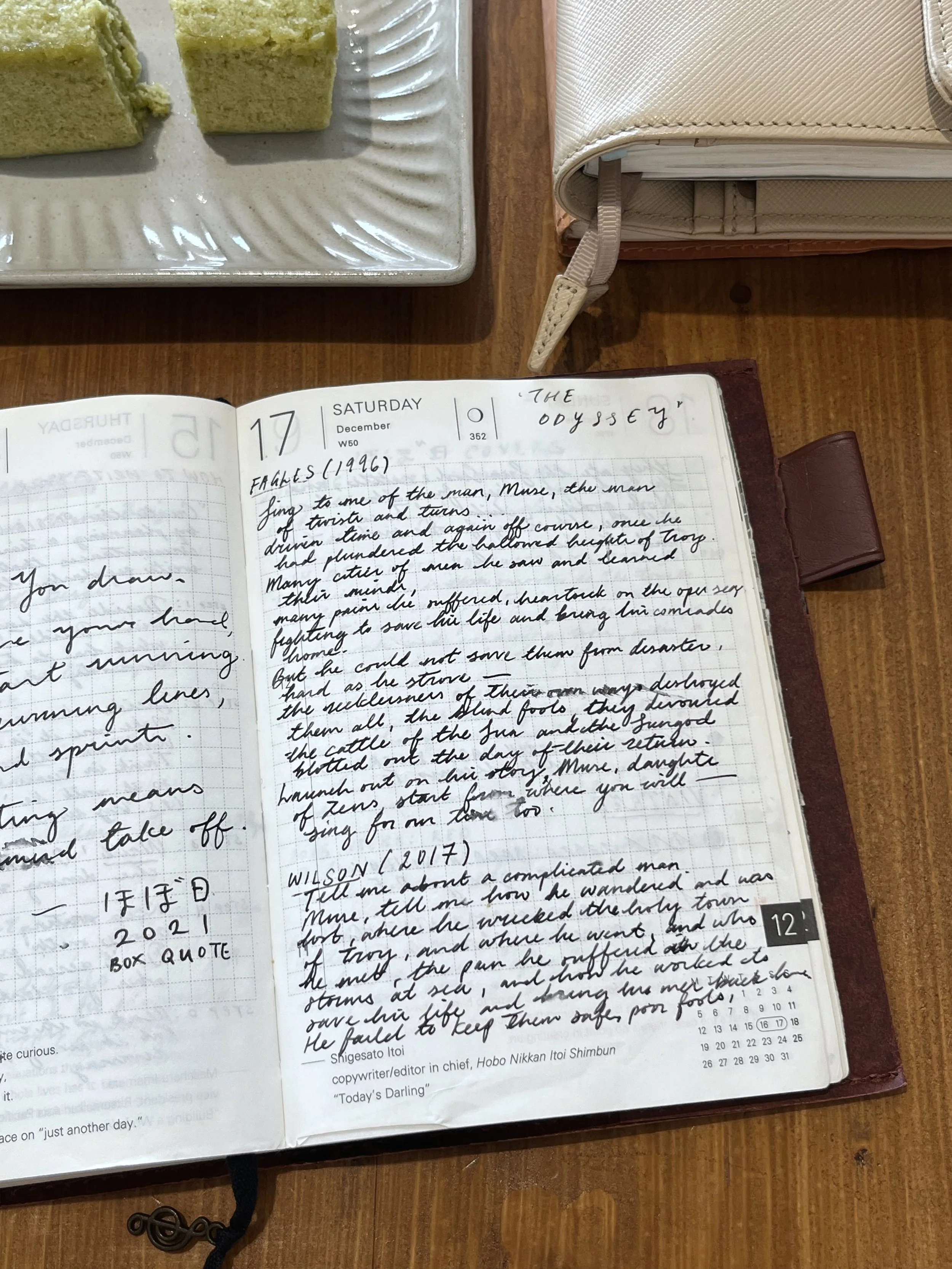
As I paged through the book in the depths of a depressive funk, guilt began to creep in. I couldn’t help but wonder how much I had let this younger self of mine down. What had I done with all that enthusiasm and excitement? But then the depression eased, and so did my perspective.
I realised that Darnton’s promise of the commonplace book’s reflective qualities holds true, but only to a degree. A caveat is necessary: a finished commonplace book is a reflection of its owner at their best self. This book is a perfectly optimistic reflection of only some parts of my 2016 self, because a commonplace book by definition, contains nothing about real lived life. It reflects one’s intellectual interests and reading habits, and sure those may say something about one’s life, but not the small acts that make up the days and one’s real day-to-day living — unless, of course, you change how you use the book. Which I realised, going through the subsequent books, I did.
Volume 2 (September 2020 - April 2022)
Of the three books, I put off opening this one until the very end because I dreaded it so much. This poor book had the misfortune of accompanying me through the depths of a global pandemic that seemed to never end; as I was whipped around by both constant upheaval and mindless drudgery, and subject to a number of crises and scares. I didn’t want to relive all that.
Exacerbating the issue is the fact that the notebook itself, as though in concert with the years, is an unpleasant object. Although I had started this second volume with high excitement, it quickly became apparent that nothing about it was right. It was the same size as the first book, but its paper was different and so too was its construction and design— all in bad ways. The heavier weight paper felt more rigid and unwelcoming than the Hobonichi’s silky Tomoe River paper, the glue in the binding began to crack and eventually came undone as the spine buckled from use. It was an unwelcoming book made even more so by the design of its pages. Compared to the rigidly structured Hobonichi grid, the barely visible dot grid of this book that ran right up to the edges of the paper made my writing slip all around the formless page.
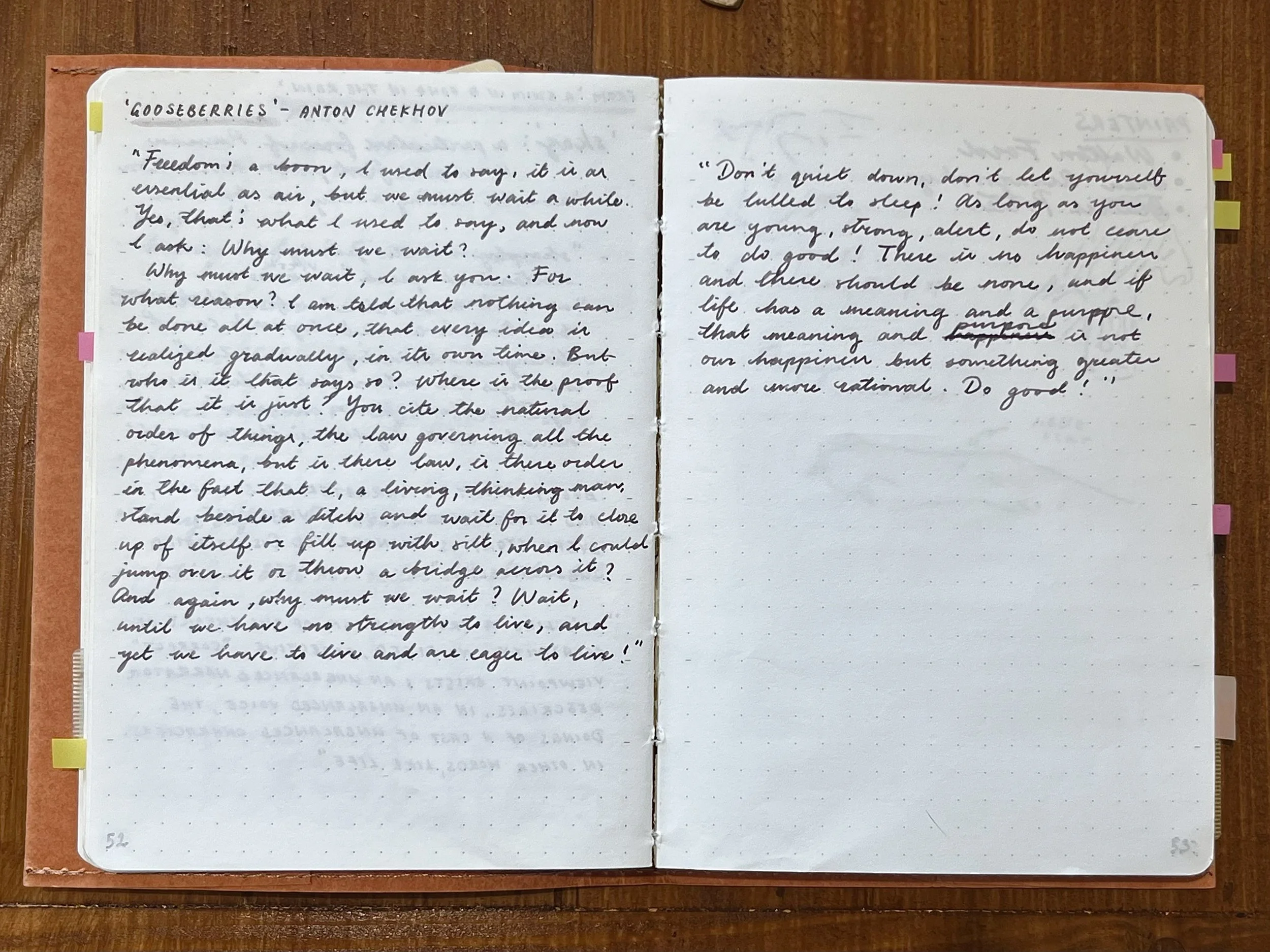
There is one good thing I can say about this book. Eager to use up the pages without actually writing in it, I threw everything at it. The book came to hold everything, and so became a true record of life: the usual commonplace entries, but also an Animal Crossing to do list, a catalogue of my dog’s treats, recipes I wanted to try. I even took to pasting labels in it: craft beer, scented candles, shower gels— all things that helped me get through the stagnancy and horror of the pandemic. This book can barely be called a commonplace, but perhaps that was its true value. It was and is an ugly book. But is there anything that captures life better than such a notebook?
Volume 3 (April 2022 - now)
If anything, this book is defined by an evolution of style, some learned from experience and others forced by circumstances out of my control.
The first lesson: structure. The previous book made me realise that margins and structured pages are the most important factors in how usable and pleasant my pages feel. I chose a Stalogy notebook with a 5mm grid and in-built margins to keep my handwriting contained. I give myself more structure by splitting the page further, drawing a simple margin five grid spaces in. At the top of this column, I write the title of my entry, and save the rest of the space for notes, such as linkages to other pages or comments I might have later.
And then in 2023, I found myself having to travel between and live in two different countries. I had to adapt my commonplacing habit to fit this new life, making modifications to streamline and simplify. These changes ended up really working for me, and are mainstays of my practice to this day.
It turns out simplifying what you carry with you has the pleasant side effect of reducing decision fatigue and friction. While I used to love experimenting with different fountain pens and inks, I couldn’t afford to carry all that across countries. I found a refillable gel pen that worked for me (a Zebra Sarasa Grand with a 0.5mm Zebra Sarasa refill in Sepia Black) and stuck with it. The consistency helped a lot, creating a nice, uniform look to my entries.
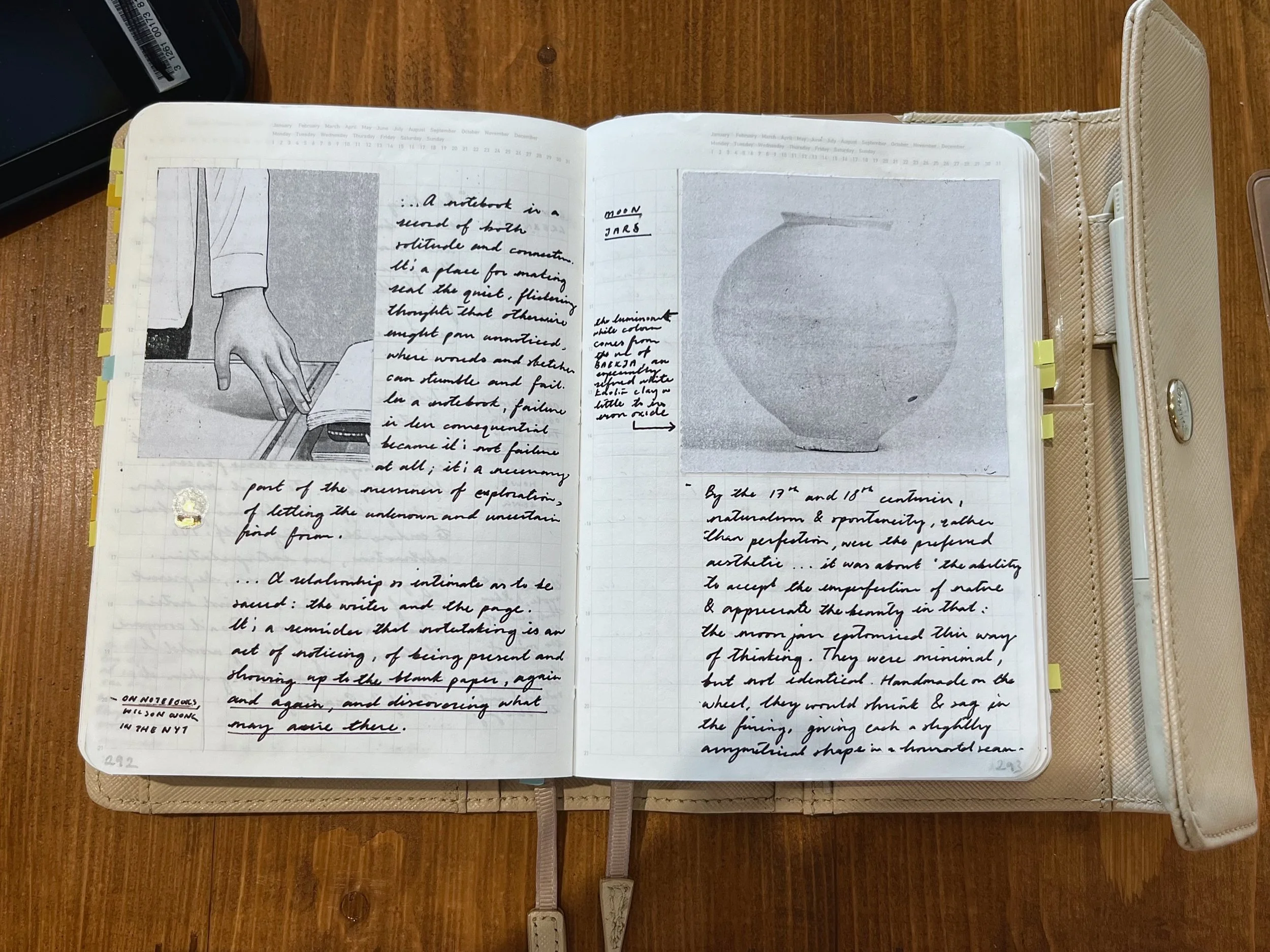
The move gave me access to a reliable home printer, so I took advantage of that to integrate pictures in my commonplace book. Besides livening up the strict structure of the pages, the extra visual cues really helped ground my memory of each entry. It’s no surprise: it’s much easier to take in a picture than a chunk of not very legible cursive! It was also another way to keep things I loved with me despite being split between two homes. Concert tickets, album covers, pieces of art, a charm or favourite plush toy… if I couldn’t carry them with me, pictures of them could still live in my pages.
As part of my streamlining, I also moved the book into a trifold leather cover. The added bulk was worth it: the cover’s built in pen loop stored my pen safely; the bookmarks made it easy to open to a fresh page and the protection offered by the trifold mechanism made me unafraid to carry it with me anywhere. There was even a back slot to hold a slim plastic file of stickers and printed pictures.
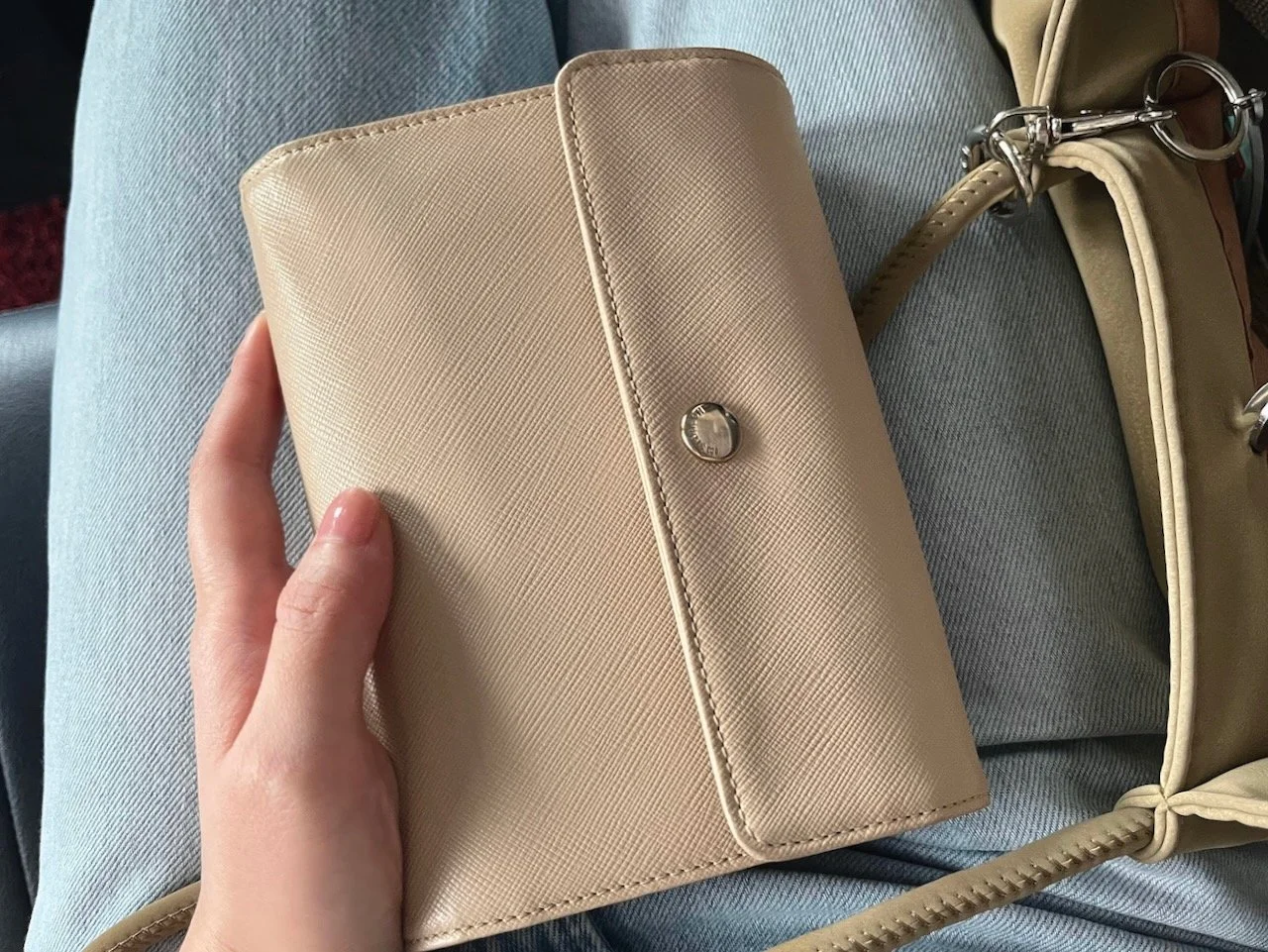
My leather trifold cover that holds everything I need for commonplacing.
If I wanted to write an entry, everything was ready at hand with the book. All I had to do was open up the cover, slip the pen out of the clip, and write. I keep the equipment for more intricate commonplace maintenance tasks—drawing margins, writing out page numbers, updating the index, pasting in pictures—in a separate pen case and catch up on that in bulk whenever I have the time.
Another addition to my process was the use of digital methods. There’s no way around it: I do a lot of reading on my phone, and I can’t always immediately sit down with my commonplace to transcribe something that catches my eye. To get around this, I wrote a Shortcut on my iPhone that lets me highlight a passage of text and send it to a designated note in the Notes app. Then when I do have the time, I copy over whatever is in that note into my commonplace book. It’s a simple system that works.
From this book’s structured, uniform pages to its self-contained simplicity, everything about this commonplace book is welcoming. Some time in 2024, I wrote, “I love the physical feel of this book: the soft leather cover, the softly bulging heft of its pages, everything inside it being everything I have loved. The more I work in it, even after a long absence, the more I want to return to it.” And there have been long absences, but I am always happy to return to it.
So what I’ve learned:
Material matters. The book itself. The paper. How its spine opens beneath your hands. The movement of of the pen nib across the page surface. Even margins on the page, line or grid size. Writing is a physical practice after all, and the physical tools matter. How a book feels affects how much you use it, and how much you use the book determines its lasting value.
Reduce friction. The best way to keep a commonplace is the way that keeps you using it. Despite all the instruction over the centuries, there is truly no right or wrong way to commonplace; you simply must work out a method that makes it as seamless and pleasurable for you.
Write everything down. You will forget. My memory is a sieve: sometimes the same quotes occur over and over again, even across different books. But if I didn’t write it down, they’d vanish. So write it all down. It’s possible you may second guess yourself. Am I writing too much? Do I really need this? Surely this is frivolous? Write it down anyway. Nothing, in hindsight, I regretted writing down. Looking back on three books now, nothing in them felt insignificant.
You forget more than you think, but you also remember more than you think. I may not remember a quote in its exact form, but I’ve found that something memorable will stick in some small form or other, and then the book (and the index you hopefully kept!) will be there for you. Someone mentions the impossibility of hope, and you remember there was an aphorism from Lu Xun that said something similar, and so you page through the index, locate the entry, and sure enough: there it is.
❦
In the end, it’s no surprise how much I love commonplacing and that I have kept up with it for a decade. I’ve always been interested in notebooks as both a literal and metaphorical space. How they exist as physical objects that are transformed by their use. A completed commonplace book holds physical ink and slips of paper, but also intangible matter such as memories, snapshots of a time, emotions, ideas.
When I was young, I tried to build games in my school-issue exercise books, turning each floppy little book into something more than just paper and staples. Maybe that’s the reason I am so captivated by the practice of commonplace books. I open my commonplace book and it is like opening the gates to a field filled with all the things I love. I can do just about anything here in these pages, in this field of my own making. Every page is shaped by me and the many different versions of me through time; every book becomes as familiar and as individual as a friend who holds my memories and who I was.
29 April 2026