Review: “Interior Chinatown”, in light of “Taiwan Travelogue”
Following the announcement that this year’s International Booker Prize went to Taiwan Travelogue, I spent the morning reflecting on my experience with the book when I read it at the end of 2024. Back then, I was disgruntled enough to write a quick review on Goodreads:
The idea this book started out with turned out to be far, far more interesting than how it actually executed it. The translators’ notes, both diegetic and real, added nothing to this supposedly layered text besides more and more onerous facts. The relationship and its commentary on coloniser-colonised that should have been central to the story both had so little substance to it.
I was disappointed, but I didn’t think much more of Taiwan Travelogue until its win. For some reason, my heart sank slightly. Admittedly, my reaction may be overblown because I’d had such high hopes for the book. I’d been completely taken in by its premise: its structure, the layered translations turning it into a frame tale of sorts; its multiple diegetic translators and editors that offered a potential for unreliability; even the presence of those translators’ footnotes and how they might add further layers to the story. Adding to all that, the novel’s supposed dealings with colonial themes and queer desire! All things I adore! All things that garnered it the International Booker Prize nomination and win, I’m sure.
But as I read it, I couldn’t shake the feeling that all of that was simply doing… nothing. All the features I mention above were present, yes, but their effect was emotionally no different than the effect of my listing them out. The disparity and disconnect between form and content was just too jarring. The relation between what the text was doing and what it was trying to say by doing that was far too superficial. It felt stilted, so caught up in its supposed message that it felt like a parable more than a nuanced piece of storytelling.
Even so, after the prize announcement (which came a few weeks after a dear and respected friend told me how much they liked it), I still questioned myself. Had I missed something about the book? Had I been too harsh? I’m not sure.
What I am sure about is that there is a book that masters the balance between form and content and messaging much better. Does it excellently, in fact.
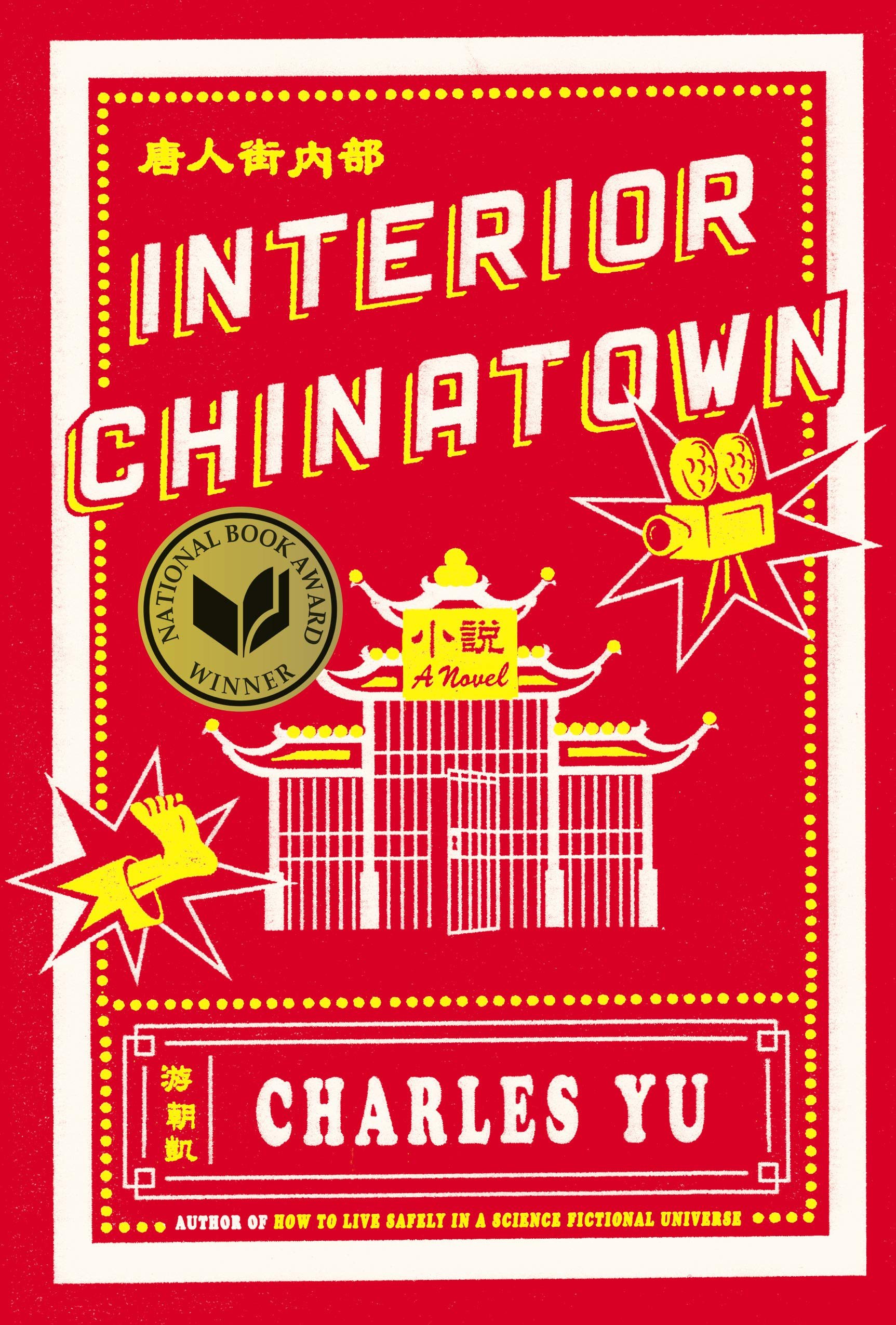
Interior Chinatown by Charles Yu. New York: Pantheon Books, 2020.
On the surface, Interior Chinatown is the story of Willis Wu, an Asian-American actor trying to make it in the world of “Black and White”, a procedural police show starring a pair of attractive black and white actors. Willis lives and works in Chinatown while trying to climb the ladder of increasingly significant roles on the show: from Background Oriental Male to Generic Asian Man, though the role he dreams of playing is that of Kung Fu Guy.
It is no coincidence that the roles sound like racial stereotypes: Young Dragon Lady, Wizened Chinaman, Lowlife Oriental, among others. Beyond being offensive as such labels are, they also demonstrate something more insidious: the way they limit perception and thus the extent to which migrants may assimilate into their new homes. This is shown most poignantly in flashbacks of Willis’ father, a Taiwanese immigrant, during his early days in America. Of all the derogatory racial slurs, the one that affects him the most is still the simplest— “Chinaman”, for how it defines him by his race and sets him apart as Other.
Setting the novel within the bounds of show business and acting provides Yu, himself a child of Taiwanese immigrants to America, with an effective backdrop to illustrate the struggle and marginalised experience of racial minorities. While Willis may be the main character in our book, he is not in the world he inhabits. Echoing the real experience of Asian-American actors in Hollywood, Willis and the other residents of Chinatown are only allowed to cycle through the few roles that have been stipulated for them and never a leading role. There is also a limit— the highest role anyone in Chinatown has ever achieved is Very Special Guest Star. Like real-life minorities, they are trapped; constrained by narratives that they are not allowed to write or star in. Even as Willis eventually achieves his dream of becoming Kung Fu Guy, it becomes clear that it is not a starring role at all, but just another limiting stereotype. Willis realises that by choosing to remain in Chinatown and accepting these stereotypical race-based roles, he is constraining himself to fit a one-dimensional identity that does not recognise his humanity or individuality.
Interior Chinatown’s immediate draw is its formatting, with the text sometimes taking the form of a screenplay—in theme with its subject matter, and also perhaps a nod to Yu’s experience as in the writers’ room of the TV show Westworld (coincidentally about sentient androids playing different roles in a hyperrealistic theme park). Yu’s decision to use the screenplay format, complete with accurately monospaced text) is not mere window dressing; it serves a purpose. It allows for the physical manipulation of text on the page to spotlight the novel’s themes in a way that traditional prose would not. This is evident from the very first two pages of the novel, which depicts the repetitive, locked-in quality of the roles Willis is allowed to play.
Ever since you were a boy, you’ve dreamt of being Kung Fu Guy.
You are not Kung Fu Guy.
You are currently Background Oriental Male, but you’ve been practicing.
Maybe tomorrow will be the day. (3)
Besides the change in role from “Background Oriental Male” to “Oriental Guy Making a Weird Face” on the next page, the text remains unchanged across both pages. Turning the page, confronted by the same block of text, the reader is subjected to the same repetitive futility Willis experiences.
In another instance, Yu makes full use the physical layout of the text on the page to illustrate Willis’ experience as a background character being sidelined by the main story. Willis’ actions and lines are aligned away from the main text, relegated literally to the margins of the page. When Willis finally decides to do something and break through the margin, his lines do so as well, slipping back to the center of the page where the story takes place.
You’re so deep in the
background, you’re
almost out of frame.
The script doesn’t
give you anything
to say (...)
You have to do
something. You step
into focus. (72)
Such instances reinforce the feeling that Interior Chinatown is a piece of fiction that truly works only on the page, one that makes full use of the qualities of its physical form. Of course, tricks of formatting would mean little without the prose that accompanies it. Yu does not disappoint here either, painting a depth of emotion with clean prose and scalpel-precise detail. Everything—whether it’s a Chinatown restaurant, the pain of watching a father grow old, a commentary on romance, homesickness or the transformative power of new parenthood—is sharply observed and described with such heartbreaking specificity that it is impossible not to be moved. This is best exemplified in a nearly paragraph-long sentence where he describes the cultural appeal of karaoke among Asian immigrants, one that I’ve not been able to forget since I read it over six years ago. With its run-on length, the sentence flows on and on, still retaining its crispness, gradually unwinding until it reaches its end and leaves you a little breathless from both the reading and emotion.
(...) locate the slightly older Asian businessman standing patiently in line for his turn, his face warmly rouged on Crown or Japanese lager, and when he steps up and starts slaying “Country Roads”, try not to laugh, or wink knowingly or clap a little too hard, because by the time he gets to “West Virginia, mountain mama,” you’re going to be singing along, and by the time he’s done, you might understand why a seventy-seven-year-old-guy from a tiny island in the Taiwan Strait who’s been in a foreign country for two-thirds of his life can nail a song, note perfect, about wanting to go home. (66)
Working in tandem with all this is the novel’s narration, which takes place in the second-person point of view and in present tense— much like stage directions of a screenplay dictated to Willis but also to you, the reader. In interviews about his work, Yu has spoken about his desire to “humanise the point of view of someone who is typically not a dimensional character.” By using second-person narration, he achieves this humanisation in the most effective way possible: he turns the sidelined character into “you”, creating a sense of involvement and investment that would not be possible with any other point of view.
It is things like this that make the reader realise that what first appears to be a story about the difficulties of being a person of colour in the entertainment industry is also a smart, sharp commentary on the often-neglected Asian-American experience.
Interestingly, Interior Chinatown does not try to convince readers of its artifice. Unlike Taiwan Travelogue, which opens (rather unsubtly, almost manipulatively) with an “Introduction to Taiwan Travelogue, New Mandarin Chinese Edition, 2020 Hiyoshi Sagako”. This is in fact a fictional note from a fictional translator on the text, yet is presented no differently from the actual, flesh-and-blood author and translator’s notes at the end of the novel. When such efforts are taken to draw the eye to a trick like this, one naturally expects there to be a purpose or a payoff. There wasn’t.
In contrast, there is no such attempt at subterfuge in Interior Chinatown. It appears comfortable in its ambiguity and never once tries to fool you into what it tries to be. These oddities — its hints at its own metafictionality, unconventional format, and surreal setting (reminiscent of the surreal theme parks that populate some of George Saunders’ best stories) — are its strengths, but can also be confusing. In the world of Interior Chinatown, it seems that everyone is an actor with a role to play and shows to act in. But it can be hard to fully grasp the nature of reality as depicted in the novel: what is real? Do you read showbiz-driven, screenplay world as literal reality that exists within the story world or as a sort of metaphorical allegory? However, the argument can be made that this confusion and ambiguity is intentional and is very much part of the novel’s overall message, as both the characters and the reader discover at the end of the story. Even the title, Interior Chinatown, is a reference to Chinatown as both a Hollywood set— an often over-exaggerated reconstruction of a remembered homeland that bears hardly any real resemblance to actual China—and a state of mind.
I am reminded once again of Kazuo Ishiguro’s 2017 Nobel Prize lecture in which he described his frustration at writing a novel that, to him, seemed too similar in method and style to a TV screenplay. To survive in a world of flashy and more visual forms of entertainment like cinema and television, Ishiguro posited that fiction had to “offer something unique, something other forms couldn’t do”. It had make full use of its form to “work properly only on the page.”
With Interior Chinatown, Charles Yu both listens to and flaunts this distinction. He blends the structure of screenplay with the traditional features of written prose to create something that truly only works on the page, a clever, moving novel that makes full use of its material and medium to thoughtfully raise complex questions about Asian-American identity, marginalisation, and the search for belonging that will resonate with anyone who has ever had to live the constrained, sidelined life of a minority. It is also a reminder that narrative devices and narratological gimmicks are all good and fun, but they must all in the end be in service of something. They must serve the story.
25 May 2026